


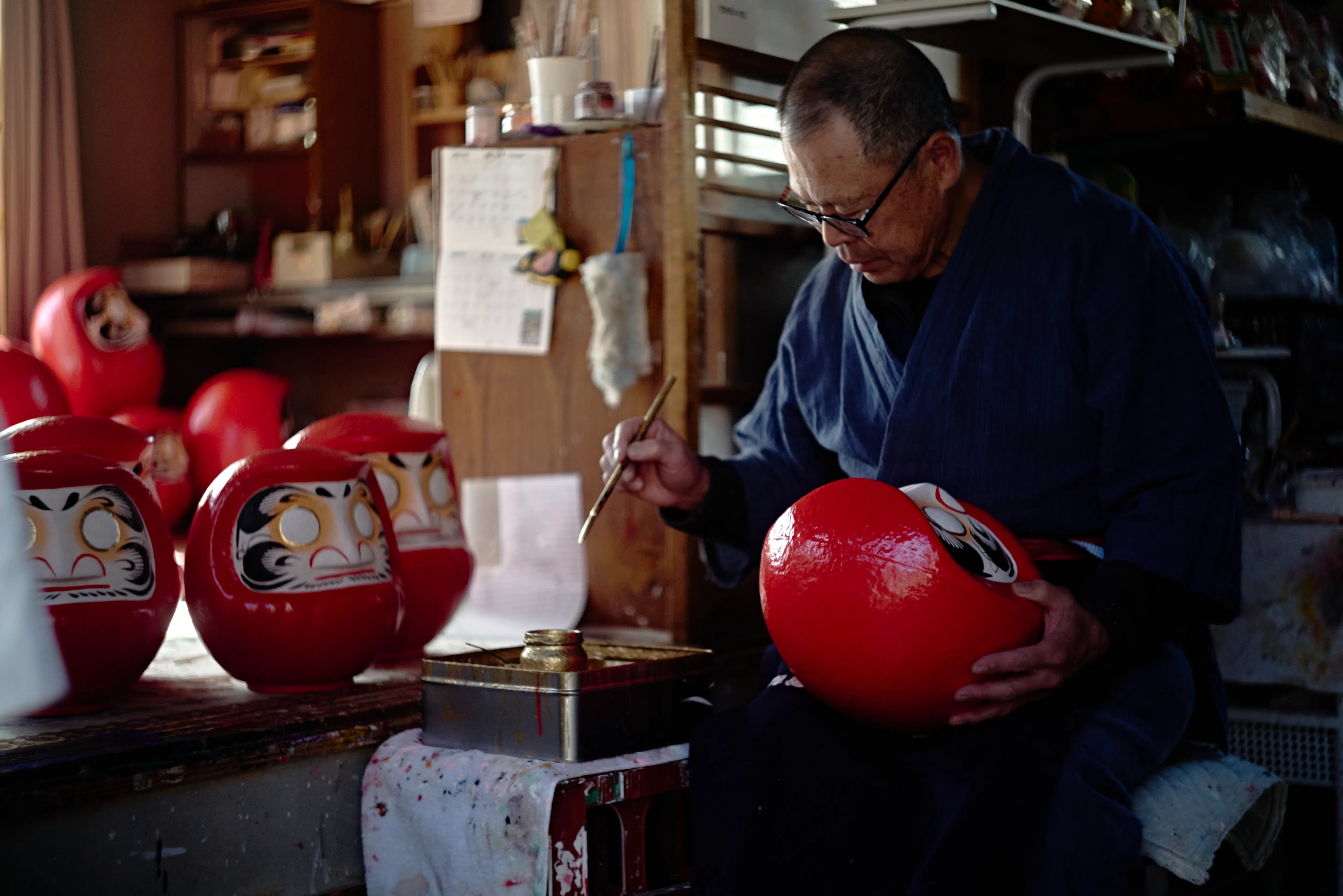

Traditional Daruma dolls are made from a hollow paper-based body, often described in English as paper pulp or papier-mâché. The body is formed and dried, given a weighted base, covered with a smooth undercoat, painted in its main color, and finished by hand with the face, inscriptions, and decorative details.
The exact method varies by workshop. Older processes built layers of paper over a mold; many makers now form wet recycled paper pulp with molds and suction or pressing equipment. Hand painting remains one of the steps that gives each finished Daruma its own expression.
How Are Daruma Dolls Made?
| Stage | What happens | Why it matters |
|---|---|---|
| 1. Form the body | Layers of paper or wet pulp take the shape of a mold | Creates the hollow, rounded shell |
| 2. Dry the shell | Moisture is removed slowly and thoroughly | Gives the paper enough strength for later work |
| 3. Finish the base | The mold opening is closed and weight is added or built into the bottom | Helps the Daruma return upright after being tipped |
| 4. Apply an undercoat | The rough paper surface is sealed and smoothed | Prepares an even surface for color |
| 5. Paint the body | Red or another main color is applied and dried | Establishes the background for the design |
| 6. Paint the details | A craftsperson adds the face, hair, lines, and often inscriptions | Creates the recognizable character of the individual doll |
| 7. Leave the eyes blank | On a goal-setting Daruma, the pupils remain unpainted | Allows the owner to complete the eye ritual |
This is the general process for a traditional hollow Daruma. Ceramic, wood, glass, resin, textile, and souvenir versions use different materials and should not be treated as evidence of how every Daruma is made.
What Are Daruma Dolls Made Of?
The familiar Japanese Daruma is usually made from paper. Depending on the workshop and translation, the material may be called:
- papier-mâché
- paper pulp
- recycled paper
- layered Japanese paper
- molded fiber
These terms can describe related but not identical techniques. A shell built from sheets over a form differs from a body made by drawing wet pulp onto a mold. Both can produce the light, hollow shape associated with a traditional Daruma.
The finished piece also contains coatings and paint. Some Daruma include a separate weight or clay-like material at the bottom; others create the right balance through the construction of the base itself. Materials therefore vary, even when the outside looks similar.
Two Ways to Form the Paper Body
Layering paper over a mold
In an older hand process, sheets or strips of paper are pasted over a wooden form. Once the layers are dry and firm, the shell is removed from the mold. The opening is then closed and the surface prepared for painting.
This method takes time because the layers and drying must be controlled. It also leaves more of the early shaping work in the craftsperson's hands.
Forming wet paper pulp
Many contemporary workshops use recycled paper that has been broken down into wet pulp. A mold, pressure, suction, or a combination of these draws the fibers into an even shell. After the body releases from the form, it must dry completely before it can be trimmed and coated.
Equipment can make the shell more consistent and speed up production, but it does not necessarily mean the entire Daruma is machine-made. Finishing and face painting may still be done one piece at a time.
The Traditional Daruma Making Process
1. Form the rounded shell
The maker prepares the paper material and places it on or into a mold. The aim is a hollow body with enough thickness to survive drying and handling without becoming unnecessarily heavy.
2. Dry it thoroughly
Drying is structural, not cosmetic. If moisture remains trapped, the shell can warp or weaken. Climate, body size, and workshop method all affect the time required.
3. Create the weighted base
The curved body and low center of gravity allow many Daruma to rock and return upright when pushed. The maker closes and shapes the lower opening, then adds or forms the base weight used by that workshop.
This self-righting motion supports the familiar idea of falling and rising again. It is a result of shape and balance, not a hidden mechanism.
4. Seal and smooth the paper
Raw paper fibers do not provide an even painting surface. A white or pale undercoat fills small irregularities and gives the main color a consistent ground. Several light applications may be used, with drying between them.
5. Add the main color
Red is the traditional color most people recognize, though modern Daruma appear in many shades. The body color is laid down before the fine facial work, so the broad surface can dry cleanly.
6. Paint the face and inscriptions
The final character appears through brushwork: eyebrows, moustache, beard, nose, mouth, cheek lines, and ornamental marks. Many Daruma also carry wish words or other inscriptions on the body or shoulders.
These details may follow a workshop style, but small differences in line, pressure, and expression remain visible. That is why individually finished Daruma do not look perfectly identical.
Why Are the Eyes Left Blank?
Many goal-setting Daruma are sold without pupils. The owner paints one eye when choosing a wish or goal and the second when it is fulfilled. The blank eyes are therefore part of how the finished object will be used, rather than an unfinished mistake.
Not every Daruma follows this convention. Decorative pieces and some regional or contemporary designs may arrive with completed eyes. The complete Daruma guide explains how the eyes, form, and symbolism fit together.
How Traditional Methods Vary
There is no single factory recipe used throughout Japan. Workshops can differ in:
- the kind of paper and recycled fiber
- whether the body is layered, pressed, or suction-formed
- the shape and material of the base weight
- undercoat and paint formulas
- drying time and equipment
- division of work among craftspeople
- facial style, inscriptions, and color
When a maker publishes details of its own process, those details describe that workshop. They should not automatically be applied to every Daruma made elsewhere.
Manufacturing a Daruma and Decorating One at Home
If you want to know how to make a Daruma doll at home, first decide whether you mean forming the paper shell or decorating a prepared blank. They are very different projects.
Making the hollow paper body from the beginning is a different project from painting a ready-made blank Daruma. Full production involves molds, wet paper, repeated drying, surface preparation, balancing, and finishing. It is difficult to reproduce faithfully in a short home session.
At-home Daruma crafts usually begin with a completed blank form. You choose a design, paint the body and face, add words or symbols, and decide how to handle the eyes. For that kind of project, follow the guide to painting a Daruma at home or explore a make-your-own Daruma kit.
Common Questions About Daruma Making
Are Daruma dolls fully handmade?
Some are made almost entirely by hand; others use molds and machinery for the paper shell before being finished by craftspeople. Check the description of the specific maker rather than assuming one process.
Are all Daruma made of papier-mâché?
No. Paper-based Daruma are the traditional form most closely associated with the craft, but modern versions also exist in ceramic, wood, glass, resin, fabric, and other materials.
Why do Daruma stand back up?
Their rounded body and low center of gravity make them self-righting. The exact base construction varies, but the balance is deliberate.
Is painting a blank Daruma the same as making one?
It is one part of the craft, not the whole manufacturing process. Painting begins after the body has already been formed, dried, balanced, sealed, and usually undercoated.
From Paper Fibers to a Finished Face
A traditional Daruma begins as paper and moisture, gains strength through shaping and drying, and becomes recognizable through paint and brushwork. Knowing that sequence makes the finished object easier to read: the round body carries the persistence, while the unpainted eyes leave the owner's goal unfinished on purpose.

