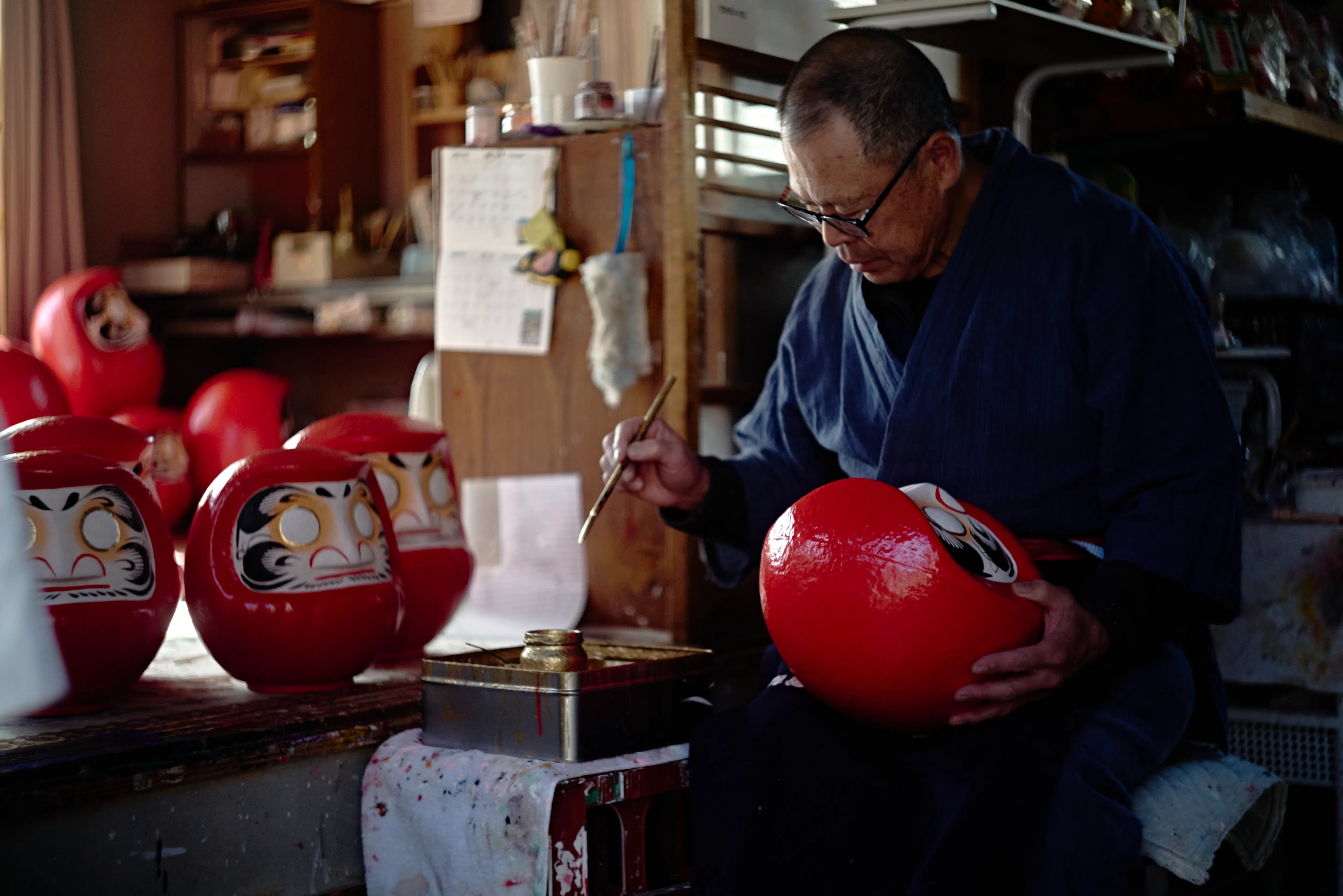
Summary — What Is a Daruma?
A Daruma is a round, hollow Japanese doll modeled after Bodhidharma, the founder of Zen Buddhism. Made from papier-mâché and traditionally painted red, it symbolizes perseverance, good luck, and resilience — embodied by the Japanese proverb “fall seven times, stand up eight” (nanakorobi yaoki). You paint one eye when setting a goal and the other when you achieve it, making it a uniquely interactive goal-setting tool. The vast majority of Daruma produced in Japan come from Takasaki City in Gunma Prefecture (Source: Gunma Daruma Manufacturers Cooperative, takasakidaruma.net), where artisans have handcrafted them for over 200 years.
This guide covers everything: Daruma’s Zen origins, the remarkable history of Takasaki Daruma, the handmade production process, the eye-painting ritual, the meaning of each color, and how to use a Daruma for modern goal-setting — with exclusive artisan interviews and workshop photos you won’t find anywhere else.
Table of Contents
1. What Is a Daruma? — Meaning & Symbolism
2. The History of Daruma: From Bodhidharma to Japanese Folk Craft
3. Takasaki Daruma: Why the Vast Majority of Japan’s Daruma Come From One City
4. How Takasaki Daruma Are Made: The Production Process
5. The Design of Takasaki Daruma: Every Detail Has Meaning
6. How to Use a Daruma: The Eye-Painting Ritual & Goal-Setting
7. Daruma Colors and Their Meanings
8. Modern Uses of Daruma: From Tradition to Lifestyle
9. Artisan Interview: Kunji Takeuchi, Third-Generation Daruma Craftsman
10. FAQ: Frequently Asked Questions About Daruma

1. What Is a Daruma? — Meaning & Symbolism
A Daruma (達磨) is a hollow, round Japanese doll modeled after Bodhidharma — the Indian or Central Asian monk who is credited with founding the Zen tradition of Buddhism. With its bold red body, distinctive facial hair, and blank white eyes, the Daruma is one of Japan’s most recognizable cultural symbols and one of the country’s most beloved good-luck charms.
But calling it a “good-luck charm” doesn’t quite capture the full picture. A Daruma is a goal-setting tool, a symbol of resilience, and a physical expression of the Japanese proverb “fall seven times, stand up eight” (Nanakorobi yaoki / 七転び八起き). Its weighted base allows it to rock back upright when pushed over — a design feature that physically demonstrates the idea of never giving up.
The Daruma holds a unique position in Japanese culture: it is simultaneously rooted in Buddhist spiritual tradition and deeply embedded in everyday secular life. People use Daruma for exam preparation, business launches, election campaigns, sports competitions, health goals, and personal habits. It is both a sacred object of prayer and a practical companion for action.
This dual nature — spiritual depth combined with practical utility — is what makes the Daruma so enduringly powerful. It doesn’t simply represent a wish. It represents a commitment: a promise you make to yourself, marked by the act of painting in one eye, and fulfilled by painting in the other.

2. The History of Daruma: From Bodhidharma to Japanese Folk Craft
Bodhidharma: The Monk Behind the Doll
The Daruma doll takes its name and form from Bodhidharma (Daruma Daishi in Japanese), a monk who lived around the 5th–6th century CE. Bodhidharma is traditionally credited with bringing the Zen school of Buddhism from India to China, where he is said to have practiced intense seated meditation (zazen) at the Shaolin Temple.
According to the most widely told legend, Bodhidharma meditated facing a wall for nine continuous years. His dedication was so extreme that, according to tradition, his limbs withered from disuse. This story — of a man so committed to his goal that his body transformed around his resolve — became the foundational narrative for the Daruma doll’s limbless, round form.
It should be noted that the historical details of Bodhidharma’s life are the subject of considerable scholarly debate. Much of what is “known” about him comes from hagiographic accounts written centuries after his death. The legend of the nine-year meditation and the loss of limbs is not a verified historical fact but rather a deeply influential narrative within East Asian Buddhist tradition.
From China to Japan: The Okiagari-kobōshi Connection
The Daruma doll’s tumbler design — a self-righting figure that always returns to an upright position — draws on an older Chinese toy tradition. The Chinese “bùdǎowēng” (a roly-poly figure) was introduced to Japan, where it evolved into the okiagari-kobōshi: a small self-righting monk figure that became popular in Japan.
It is believed that the modern Daruma emerged in the 18th century when the spiritual imagery of Bodhidharma was combined with the okiagari-kobōshi tumbler form. The exact date and location of this fusion are uncertain, but by the mid-19th century the two were firmly linked in Japanese popular culture.
Daruma as Folk Craft: Talismans for the People
During the Edo period (1603–1868), Japan saw a flourishing of regional folk crafts, and Daruma dolls became woven into the fabric of daily life. What makes the Daruma’s cultural evolution distinctive is that it served a dual purpose: it was both an object of prayer and a means of livelihood. People made wishes upon Daruma, but they also made Daruma by hand, sold them at markets, and supported their families through the craft.
This intersection of spiritual practice and economic survival gave the Daruma a particular depth of meaning that other lucky charms often lack. The Daruma was never just about receiving good fortune — it was about taking action, working with your hands, and rebuilding your life. This origin story is most powerfully embodied in the history of Takasaki.

3. Takasaki Daruma: Why the Vast Majority of Japan’s Daruma Come From One City
The Origin: Famine, a Temple, and a Path to Recovery
Takasaki City in Gunma Prefecture is the undisputed capital of Daruma production in Japan, responsible for the vast majority of the country’s total output. But Takasaki’s connection to Daruma is not merely industrial — it is deeply historical and emotional.
The story begins in the late Edo period, during the Tenmei Famine (1782–1788), one of the most devastating famines in Japanese history. As crops failed and hunger spread, a Zen priest named Tōgaku at Shorinzan Daruma-ji Temple carved wooden molds and taught local villagers how to make papier-mâché Daruma dolls. His motivation was explicitly practical: he wanted to give people a way to work with their hands, steady their minds, and rebuild their livelihoods (Source: Gunma Daruma Manufacturers Cooperative, takasakidaruma.net/daruma/history/).
“Work with your hands, settle your mind, and rebuild your life.” This was the spirit behind Tōgaku’s instruction — and it mirrors the very essence of what a Daruma represents: rising again after falling.
Zen Craftworks Exclusive
Zen Craftworks has a direct partnership with workshops in the Takasaki Daruma-making community. The photos, video footage, and artisan interviews featured in this article are original first-hand materials, rarely published in English.
Why Takasaki? Climate, Silk, and Railways
Several factors converged to make Takasaki the ideal location for Daruma production:
Climate: The winters in Takasaki bring dry air and strong winds — ideal conditions for drying the multiple layers of paper and paste that make up a papier-mâché Daruma. This natural advantage made large-scale production practical long before modern drying technology existed.
Sericulture connection: Takasaki was historically a major center for silkworm farming. The Daruma’s round, cocoon-like shape resonated deeply with silk farmers, who saw it as a symbol of prosperity and abundance. This cultural affinity drove strong local demand and emotional attachment.
Railway expansion: When railways were built through Takasaki during the Meiji era, craftsmen could transport their Daruma to markets across Japan. What had been a local folk craft rapidly became a nationally known product.
From Regional Craft to National Symbol
In the postwar period, Takasaki Daruma became closely associated with “hisshou” (certain victory). Politicians began using large Daruma at election headquarters, painting in one eye when launching a campaign and the other upon winning. Students adopted the same ritual for university entrance exams. Sports teams placed Daruma in their clubhouses. The Daruma’s role expanded from a spiritual folk object into a mainstream symbol of determination.
Every January, the Shorinzan Daruma-ji Temple hosts the “Nanakusa Taisai” (Seven Herb Grand Festival), also known as the Takasaki Daruma Market, where hundreds of thousands of visitors gather to purchase new Daruma for the year. It is one of the largest New Year’s festivals in the Kanto region and a living testament to the Daruma’s central role in Japanese life.
4. How Takasaki Daruma Are Made: The Production Process
Every Takasaki Daruma is handcrafted through a multi-step process that has been refined over two centuries. Unlike mass-produced souvenirs, each doll passes through dozens of stages involving natural materials, skilled hands, and patient drying time. Here is how a single Daruma comes to life:
Step 1: Creating the Paper Base (Hariko)
The process begins with the body. Recycled paper and paper pulp are soaked in water and broken down into a mud-like paste. This paste is then layered and pressed into a wooden mold to create the iconic round shape. Once partially dried, the shell is carefully removed from the mold. This technique — called hariko (papier-mâché) — gives the Daruma its lightweight, hollow structure and that characteristic roly-poly base.
The use of recycled materials is not a modern sustainability trend — it has been part of the tradition from the very beginning. Paper that has served one purpose is given new life as a vessel for someone’s deepest wish.

Step 2: Gofun Coating (White Base Layer)
Once fully dried, the shells are coated with gofun — a fine white powder made from crushed seashells — mixed with nikawa, a natural animal-derived adhesive. Multiple coats are applied and carefully dried between each layer. This process gives the Daruma its signature smooth, porcelain-like surface texture and brilliant white base. The technique requires years of experience to execute properly; too much gofun cracks, too little leaves an uneven finish.

Step 3: Red Paint Application
The body is painted with deep red paint, the Daruma’s most iconic color. Traditionally, this red represents the robes of a high-ranking Buddhist priest — and since Bodhidharma was the founder of Zen Buddhism, his Daruma is depicted in this auspicious color. The red also carries associations of protection against evil and recovery from illness in Japanese folk tradition (manufacturing process details per Gunma Daruma Manufacturers Cooperative, takasakidaruma.net/daruma/process/).

Step 4: Face Painting — The Most Skilled Stage
The face is painted entirely by hand, and this is where the artisan’s mastery is most visible. The eyebrows are drawn in the shape of a crane, and the cheek hair (often called the “beard”) is drawn to resemble a turtle. In Japanese culture, the crane and turtle are classic symbols of longevity — as the saying goes, “cranes live a thousand years; turtles live ten thousand.”
The blank white circles left for the eyes are large and symmetrical — waiting for the owner to fill them with purpose. The golden calligraphy on the belly reads “Fukuiri” (福入), literally meaning “good fortune enters here.” Additional wishes like “family safety” or “business prosperity” are often written on the shoulders of larger dolls.

Step 5: Calligraphy and Finishing
Gold calligraphy is applied to the belly and shoulders. Each character is painted by hand with a fine brush. After the gold ink dries, the Daruma receives a final quality inspection before being sent to market. From start to finish, a single Daruma may take several weeks to complete, depending on size and complexity.

💡From the Workshop
Zen Craftworks photographed and filmed the Daruma-making process inside partner workshops in Takasaki. These original materials capture real tools, real hands, and real details—rarely shown in English and hard to convey through stock photos or secondhand summaries.
5. The Design of Takasaki Daruma: Every Detail Has Meaning
The design of a Takasaki Daruma is not decorative — it is symbolic. Every element, from the facial hair to the body shape, carries a specific meaning rooted in Japanese traditions of fortune and longevity.
|
Design Element |
Visual Form |
Symbolic Meaning |
|
Eyebrows |
Shaped like a crane |
Longevity (“cranes live 1,000 years”) |
|
Cheek hair / Beard |
Shaped like a turtle |
Longevity (“turtles live 10,000 years”) |
|
Belly calligraphy |
福入 (Fukuiri) |
“Good fortune enters here” |
|
Shoulder calligraphy |
商売繁盛 / 家内安全 etc. |
Specific wishes (prosperity, family safety) |
|
Eyes |
Blank white circles |
To be filled by the owner: a personal commitment |
|
Round body shape |
Cocoon-like, low center of gravity |
“Always rises again” — resilience and stability |
|
Red color |
Traditional red paint |
Buddhist robes, protection, good fortune |
|
Weighted base |
Roly-poly mechanism |
Nanakorobi yaoki: fall seven times, stand up eight |
The master craftsman Ashina Tetsujuro is credited with refining the round, stable Takasaki Daruma form during the Meiji period (Source: Gunma Daruma Manufacturers Cooperative). His contribution elevated the Daruma from a rustic folk toy to an object of refined beauty that balances softness with strength — a hallmark of the Takasaki aesthetic.

6. How to Use a Daruma: The Eye-Painting Ritual & Goal-Setting
The most famous custom associated with Daruma is the eye-painting ritual. This is not simply a superstition — it is a structured practice for setting, committing to, and completing a goal.
Step-by-Step: The Daruma Eye-Painting Ritual
Step 1: Choose your goal. Select one specific, actionable goal for this Daruma. “Pass my certification exam,” “Launch the new product by March,” “Exercise every day for 90 days” — the more concrete, the better. Daruma works best when tied to a commitment you can act on, not an abstract wish.
Step 2: Paint the first eye. Using a brush or marker, fill in the right eye (as you face the Daruma). This act represents your declaration of intent. The Daruma now carries your promise.
Step 3: Place the Daruma where you’ll see it daily. A desk, a shelf near your workspace, a kitchen counter, an entryway — anywhere that keeps the one-eyed Daruma in your line of sight. The blank eye serves as a constant, gentle reminder of what you’re working toward.
Step 4: Take action. A Daruma is not a passive good-luck charm. Think of it as a partner in accountability. Some people use weekly check-ins with their Daruma: reviewing progress, reassessing strategy, and recommitting to the goal.
Step 5: Paint the second eye. When the goal is achieved, paint in the remaining eye. This moment transforms the Daruma from a symbol of effort into a symbol of gratitude and accomplishment.
Step 6: Return or retire the Daruma. Completed Daruma are traditionally returned to a temple at the end of the year, where they are respectfully burned in a ceremony called Daruma Kuyō. This act expresses thanks and makes space for a new goal with a new Daruma. Alternatively, you may keep a completed Daruma as a personal memento of your achievement. The key is to treat it with gratitude and respect.

💡Pro Tip: One Daruma, One Goal
Try not to assign multiple goals to a single Daruma. This tradition works best when your intention is clear. If you have several goals, use one Daruma for each. Seeing a few one-eyed Daruma on your shelf—each tied to a different intention—can help you stay focused.
Which Eye Do You Paint First?
The most common practice is to paint the right eye first (as you face the Daruma, which is the doll’s left eye). However, regional customs vary, and some traditions specify the left eye first. The important thing is the intention and the process: one eye for the commitment, one for the completion.
7. Daruma Colors and Their Meanings
While red is the original and most traditional Daruma color, modern Daruma are available in a wide variety of colors, each associated with different types of wishes. These color associations have developed over time and can vary somewhat between producers and regions. The following meanings represent the most commonly accepted interpretations:
|
Color |
Common Associations |
Best For |
|
Red |
Protection, good fortune, family safety |
General good luck; the classic Daruma for first-time owners and all-purpose wishes |
|
Black |
Business success, warding off misfortune |
Entrepreneurs, shop owners, career-driven professionals |
|
White |
Purity, academic success, fresh beginnings |
Students, exam preparation, starting a new chapter in life |
|
Gold |
Wealth, financial prosperity |
Business growth, investment goals, revenue targets |
|
Blue |
Career advancement, intellectual growth, calm focus |
Promotions, skill development, studying |
|
Green |
Health, physical well-being, inner balance |
Fitness goals, recovery, lifestyle changes |
|
Yellow |
Safety, protection during travel |
Frequent travelers, family safety wishes |
|
Pink |
Love, relationships, social harmony |
Romantic goals, strengthening personal connections |
Note: Color meanings are not fixed doctrines. They are cultural conventions that have evolved over time and may differ between workshops, regions, and individual artisans. In recent years, custom colors, corporate branding collaborations, and interior-design-friendly pastels have expanded the palette further — a sign that Daruma tradition is alive and adapting, not frozen in the past.

8. Modern Uses of Daruma: From Tradition to Lifestyle
Daruma have evolved far beyond temple festivals and New Year’s rituals. Today, they appear in boardrooms, home offices, fitness studios, and classrooms around the world.
Traditional Uses (Still Going Strong)
Election campaigns: Japanese politicians are famously photographed painting the eye of a large Daruma when declaring candidacy, and completing the second eye on election night. University exams: Students purchase Daruma before Japan’s notoriously difficult entrance examination season. Business launches: Company founders place Daruma in offices as a symbol of ambition and persistence.
Modern Lifestyle Uses
Personal goal-setting: From “Run a marathon” to “Learn 1,000 kanji,” individuals use Daruma to track long-term personal goals. Team objectives: Companies use a shared Daruma to visualize and rally around group targets — a powerful way to make abstract OKRs feel tangible. Interior design and art: Daruma’s bold form and striking colors make it a natural conversation piece in modern interiors. Internationally, Daruma is increasingly recognized as a symbol of Japanese resilience.
Daruma as a Gift
Daruma make meaningful gifts for graduations, new jobs, business openings, recovery from illness, or any moment that marks a new beginning. Unlike generic decorations, a Daruma carries a message: “I believe in your ability to achieve your goal.”

9. Artisan Interview: Kunji Takeuchi, Third-Generation Daruma Craftsman
Zen Craftworks Exclusive — First-Party Interview
The following interview was conducted by Zen Craftworks at the Takeuchi Daruma workshop in Takasaki, Gunma Prefecture. This is original content not available elsewhere.
Kunji Takeuchi is the third-generation head of Takeuchi Daruma Shop, a family workshop that has been crafting Daruma since around 1937, when his grandfather first began production. Takeuchi-san carries on the tradition with quiet dedication and a deep sense of responsibility.
On His Family’s History
“My grandfather started around 1937 at the main family house, and then my father branched off and established his own workshop. I inherited it from him and continue the work today.”
On His Craft Philosophy
“I uphold the traditions of Takasaki Daruma while sincerely making each doll so that the wishes of the people who receive them may come true. Every single one is made with care. I craft each Daruma thinking about how it will become a source of support and comfort for the person who holds it.”
On the Crane and Turtle Design
“The upper part of the face shows the head of a crane, with the body formed in the design below. The beard represents a turtle. As the saying goes, ‘Cranes live a thousand years, turtles ten thousand’ — these symbols of longevity and vitality are the reason for this design.”
On What Brings Him Joy
“When customers tell me their wishes came true, or when I see them again at the Daruma market and they say, ‘I had a safe and good year, so I’ve come back’ — that’s the greatest happiness for me. People returning year after year, letting me see their faces — that is what makes this work worthwhile.”
On Tradition and Innovation
“Recently, there are Daruma with zodiac animal motifs, bold beard designs, and vivid new color schemes. But I believe in honoring the ‘heart of Daruma’ — the traditional spirit — while taking one step forward. I want to create Daruma that younger generations can embrace too, without losing what makes Daruma meaningful.”
On the Future
“Daruma has a history of about 200 years. Through all those generations, our predecessors passed down both the technique and the spirit. I want to continue making Daruma with sincerity, so that even as times change, people will keep loving them. Successors are emerging, too. As long as we keep making Daruma that improve people’s lives and help their wishes come true, I believe that will also lead to our own growth as craftspeople.”

10. FAQ: Frequently Asked Questions About Daruma
What is a Daruma doll?
A Daruma is a round, hollow Japanese doll modeled after Bodhidharma, the founder of Zen Buddhism. It is made from papier-mâché, traditionally painted red, and used as a good-luck charm and goal-setting tool. The Daruma’s weighted base allows it to return upright when tilted, symbolizing perseverance and the Japanese proverb “fall seven times, stand up eight.”
Why are Daruma’s eyes blank?
Daruma dolls are sold with blank white eyes so the owner can participate in a goal-setting ritual. You paint one eye when you set a specific goal, and the other eye when you achieve it. The blank eye serves as a daily visual reminder of your unfinished commitment.
Which Daruma eye do you paint first?
The most common practice is to paint the right eye first as you face the Daruma (the doll’s left eye). However, customs can vary by region. The key principle is consistent: one eye marks the beginning, the other marks the completion.
What do the different Daruma colors mean?
Red is the traditional color, associated with protection and good fortune. Black is popular for business success, white for academic goals and purity, gold for wealth, blue for career growth, green for health, yellow for safety, and pink for love. These color meanings are cultural conventions and may vary between producers.
Where should I place my Daruma?
Place your Daruma somewhere you will see it every day: a desk, shelf, entryway, or workspace. The purpose is to keep your goal visible and top of mind, so it can inspire daily action.
Can I have more than one Daruma?
Yes. However, the recommended practice is one Daruma per goal. Each Daruma should represent a single, specific commitment. Having multiple Daruma for different goals is perfectly fine.
What happens when my wish comes true?
Paint in the second eye to mark your achievement and express gratitude. Many people then return the completed Daruma to a temple, where it is burned in a respectful ceremony called Daruma Kuyō. You can also keep it as a personal memento.
Why is Takasaki famous for Daruma?
Takasaki City in Gunma Prefecture produces the vast majority of Japan’s Daruma dolls. The tradition dates back over 200 years to the Tenmei Famine, when a Zen priest at Shorinzan Daruma-ji Temple taught local villagers to craft Daruma as a means of rebuilding their livelihoods. The region’s dry climate, silk-farming heritage, and railway connections all contributed to its growth as Japan’s Daruma capital.
What is a Daruma made of?
Traditional Daruma are made from washi (Japanese paper) or recycled paper pulp, shaped using wooden molds in a papier-mâché technique called hariko. The surface is coated with gofun (crushed seashell powder) and nikawa (natural adhesive), then painted with red paint and finished with hand-painted facial features and gold calligraphy.
Is Daruma a religious object?
Daruma has roots in Buddhist tradition, as it is modeled after Bodhidharma. However, in modern Japan it functions primarily as a secular cultural symbol of perseverance and goal-setting. It is used by people of all backgrounds and beliefs, and purchasing or using a Daruma does not require any religious affiliation.
Conclusion: Daruma Is More Than a Doll
A Daruma is not a decoration. It is not a souvenir. It is a 200-year-old tool for turning intentions into action, shaped by Zen philosophy, forged in the hardship of famine, and refined by generations of Takasaki artisans who have poured their skill and spirit into every single piece.
It carries the essence of Bodhidharma’s unwavering focus, the pragmatic wisdom of Edo-period villagers who turned craft into survival, the master touch of artisans like Kunji Takeuchi who continue the tradition today, and the universal human desire to set a goal, commit to it, and see it through.
The Daruma’s message is simple and timeless: no matter how many times you fall, you can always stand up again.
Experience the Art of Daruma with Zen Craftworks
Zen Craftworks offers hands-on Daruma art experiences using authentic materials from Takasaki workshops. Paint your own Daruma on canvas, learn the traditional techniques directly connected to the artisans featured in this article, and create a meaningful piece of Japanese art in your own home. Visit zen-craftworks.com to learn more.


