


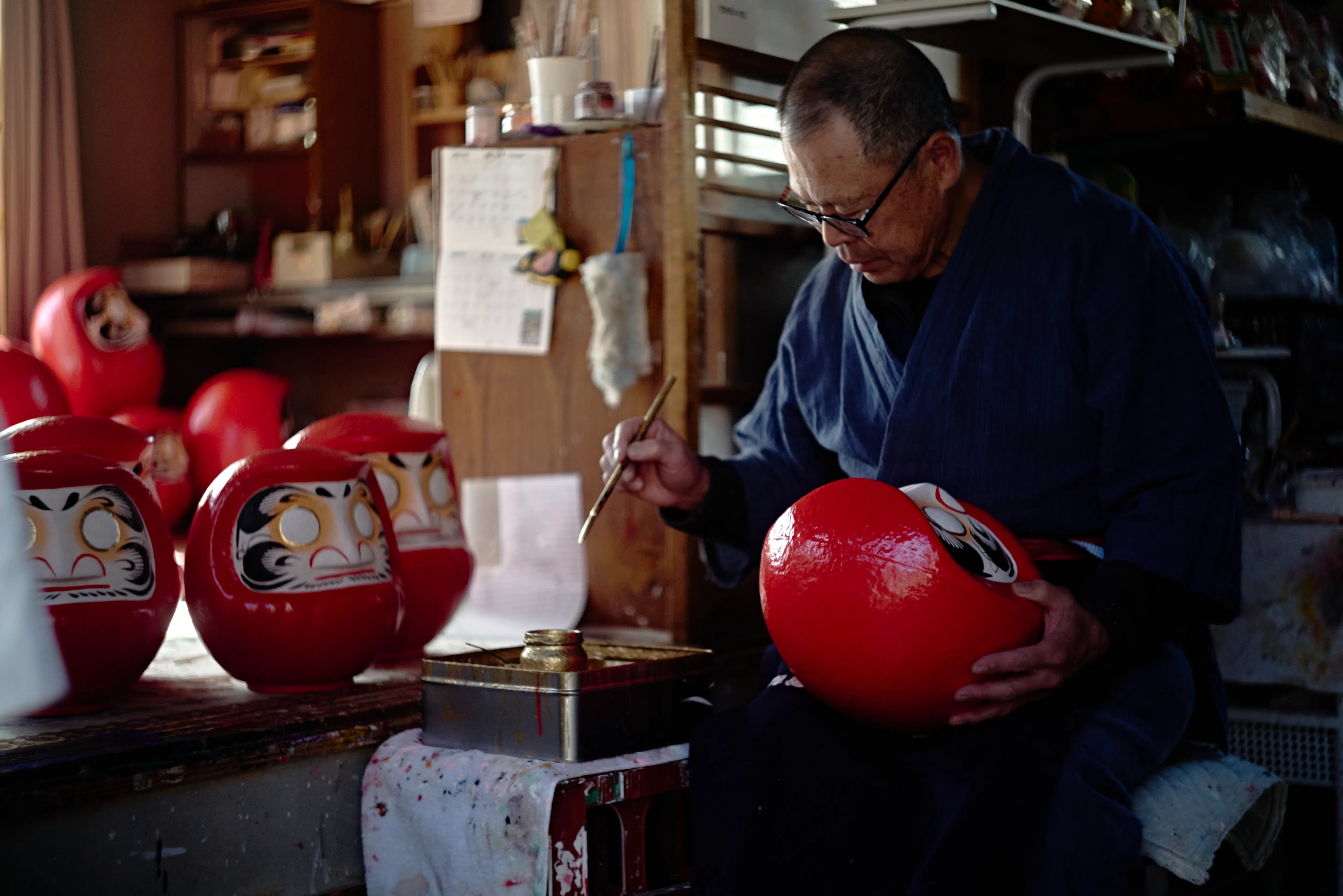

To choose a Daruma doll, start with the goal, then choose the color, size, and type that make that goal easy to remember. For most first-time buyers, the safest choice is a classic red Daruma in a size you can keep visible every day. Choose a more specific color, larger size, or paint-your-own option only when it clearly fits the goal or the person receiving it.
Before you buy, also check the actual material, dimensions, eye style, and writing on the body. A Daruma intended for goal setting should normally have blank pupils; one with completed eyes may be designed mainly for display.
The quickest way to choose
| Decision | Ask yourself | Reliable first choice |
|---|---|---|
| Goal | What one outcome will this Daruma represent? | A specific goal with a clear finish |
| Type | Do I want a ready object or a making activity? | Finished Daruma for immediate use |
| Eyes | Will I follow the goal ritual? | Blank pupils |
| Color | Is there a stated meaning for this model? | Red when unsure |
| Size | Where will it stay? | 12–20 cm for many desks and shelves |
| Material | Do I want traditional craft qualities? | Papier-mâché with clear origin details |
| Message | Is it for me or someone else? | Let the owner choose the goal |
If every option still feels open, choose a small or medium red papier-mâché Daruma with blank pupils. It is easy to explain, easy to place, and suitable for a wide range of goals.
1. Choose the goal before the doll
A Daruma works best when it represents one commitment. “Complete my certification by November” gives the unfinished eye a clear role. “Be successful” is harder to act on and harder to know when to complete.
The goal can involve study, work, a creative project, a new habit, a business milestone, or a personal beginning. It should be something the owner can influence through action. A Daruma can carry hope, but it cannot guarantee an external result.
If you need help turning a wish into a usable statement, start with these Daruma wish examples.
2. Decide between finished and paint-your-own
Choose a finished Daruma when you want to begin the eye ritual immediately. This is the simplest route for a first purchase, a formal gift, or a goal that already has a start date. “Finished” should refer to the body and face; the pupils can still remain blank.
Choose a paint-your-own Daruma when the creative process is part of the experience. You will need time for the body color and details to dry before you set the goal and paint the first pupil. It suits people who enjoy making, families, and personal projects where the design itself matters.
Choose a fully painted decorative Daruma when the object is for display or collection rather than a goal ritual. Check the eyes in the product photos so you know which type you are buying.
Neither route is more meaningful by itself. The right choice depends on whether you want to start with a ready symbol or create that symbol first.
3. Check the eyes before buying
Blank pupils are the clearest sign that the Daruma is ready for a personal goal. The common sequence is:
- Set one goal and paint the first pupil.
- Keep the Daruma somewhere visible while you work.
- Paint the second pupil when the goal is achieved.
Which eye comes first can vary by local custom or maker. Follow the instruction supplied with the doll when there is one. The guide to using a Daruma explains the full process and the separate article on which eye to paint first covers that convention in detail.
If the eyes are already complete, do not assume you can simply cover them. The paint and finish may not accept another layer cleanly. Choose a blank-eye model if the ritual matters.
4. Choose a color with its source in mind
Red is the traditional, all-purpose option associated with good fortune, protection, and perseverance. It is the least complicated choice for a first Daruma or a gift whose exact goal is private.
Modern Daruma appear in many colors. Gold or yellow may be sold for prosperity, black for protection or business stability, white for clarity or a new beginning, blue for study, green for health or growth, and pink for relationships. These meanings are not standardized across every maker.
Use a color association only when the product itself gives it. A gold Daruma marketed for prosperity and a gold decorative figure may not carry the same stated intention. For a full comparison, use the Daruma color meaning chart. That page owns the detailed color question; this guide uses color as one part of the buying decision.
5. Choose the size by placement
The right size is the one you can place safely and notice regularly. Seller labels such as small, medium, and large are not fully standardized, so use the dimensions rather than the name.
| Placement | Practical range | What to check |
|---|---|---|
| Small desk or narrow shelf | 6–12 cm / 2.4–4.7 in | Enough room for the rounded body |
| Desk or bookcase | 12–20 cm / 4.7–7.9 in | Visible without blocking work |
| Home office or studio | 15–23 cm / 5.9–9.1 in | Readable from your normal position |
| Reception or shared goal | 23–32 cm / 9.1–12.6 in | Stable surface and viewing distance |
| Event or storefront | 39 cm / 15.4 in and above | Handling, doors, shipping, and secure display |
Measure height, width, and depth. A round 20 cm Daruma may need more shelf depth than a flat object of the same height. The Daruma size chart gives exact comparisons and explains Japanese numbered size labels.
6. Look at material and construction
Traditional Daruma are usually hollow papier-mâché figures. A weighted base allows the body to rock and return upright, expressing the idea of recovering after a setback. Hand-painted faces may show small variations from one piece to another.
Wood, ceramic, fabric, resin, and plastic versions also exist. They can preserve the Daruma silhouette and meaning, but they may feel heavier, be more fragile, or lack the self-righting movement. Choose them because those material qualities suit you, not because every version works identically.
If Japanese craft origin matters, look for a clear place of production, material description, dimensions, and actual photographs. A vague “Japanese style” description does not establish where or how the object was made.
7. Read the face and inscription
The strong brows, beard, and moustache recall traditional depictions of Bodhidharma. On Daruma from Takasaki, facial lines may also evoke the crane and tortoise, animals connected with longevity.
The body may carry characters such as 福 (fuku, good fortune) or 必勝 (hisshō, certain victory). Inscriptions vary. Confirm the actual characters and translation if the wording is important for a gift or a specific goal.
Do not choose on color alone when the front of the doll says something more specific. The face, writing, and maker's stated meaning together provide the best context.
Which Daruma should I buy for my goal?
| Goal or situation | A sensible starting choice | Why |
|---|---|---|
| First Daruma or general goal | Red, small to medium, blank pupils | Classic and flexible |
| Study or qualification | Red, white, or maker-designated study color; desk size | Keeps the goal near the work |
| Business milestone | Red, gold, or black according to the maker; medium or large | Visible in a shared work setting |
| New beginning | Red or a model identified for new starts | Broad encouragement without overclaiming |
| Creative project | Paint-your-own, small or medium | Making becomes part of the commitment |
| Private personal goal | Compact Daruma in a personally meaningful color | Easy to keep visible without public display |
| Gift | Red finished body with blank pupils | The recipient can choose the goal |
This table narrows the options; it does not replace the description for the individual doll. When a maker assigns a different meaning, use that information.
Choosing a Daruma as a gift
A Daruma is most comfortable as a gift when it encourages a beginning: an exam, graduation, new job, business launch, move, or creative project. Give the object with both pupils blank so the recipient can define the goal.
If you do not know their intention, red is safer than a highly specific modern color. A small or medium size is easier to place than a large statement piece. A paint-your-own kit works when the recipient enjoys craft; a finished body works when they would rather begin the ritual immediately.
The guide to Daruma gift meaning covers wording, occasions, and boundaries in more detail.
Buying checklist
Before placing an order, confirm:
- the actual height, width, and depth;
- the material and country or region of production;
- whether the base is designed to right itself;
- whether the pupils are blank or finished;
- what the color and inscription mean for that model;
- whether paint and tools are included in a kit;
- the later placement and available surface;
- shipping, return, and care information shown by the seller.
This checklist prevents the most common mismatch: buying a beautiful object that cannot perform the role you expected.
Common questions
Which Daruma should I buy first?
A small or medium red papier-mâché Daruma with blank pupils is the most versatile first choice. Make sure it fits a visible, stable place.
Is a bigger Daruma better?
No. A larger figure is more visible and may suit a public goal, but it does not make a wish stronger. Choose size by placement and audience.
Does the most expensive Daruma work better?
No. Price can reflect size, origin, handwork, materials, or shipping, but it does not guarantee goal achievement. Buy according to the object and its fit with your use.
Do I have to buy one at New Year?
No. New Year is a common time for new intentions, but a Daruma can begin with any meaningful project or milestone.
Where can I compare finished Daruma?
You can browse the Daruma collection after deciding on goal, color, size, and eye style. Compare each product's own measurements and description.
Choose the Daruma you can actually use
The best Daruma is not automatically the largest, rarest, or brightest one. It is the figure whose meaning you understand, whose eyes match your purpose, and whose size allows it to stay present in daily life. If you want the complete cultural background before buying, read the Daruma guide.

