


A workable Kyoto craft and culture itinerary puts the confirmed workshop first, visits earlier-closing cultural sites next, leaves enough time for lunch and walking, and ends at the place with the latest admission window. Choose a workshop that produces an item you can carry the same day.
The central route below runs roughly from 9:00 a.m. to 4:50 p.m. It works best Wednesday through Friday after every stop is checked for the selected date. Published operating facts were last reviewed on August 12, 2026.
One-day Kyoto craft and culture itinerary
| Time | Area | Activity | What must be confirmed | Transfer or overrun buffer | What you carry | If unavailable |
|---|---|---|---|---|---|---|
| 9:00–10:30 a.m. | Oike/Nijo | Make a stencil-dyed textile at Marumasu Nishimuraya | Written confirmation for the morning workshop and an item ready the same day | The 90-minute block includes choosing, making, and cleanup | One small textile and its care instructions | Move the route to another date |
| 10:30–10:45 a.m. | Oike to Nijo Castle | Walk to the East Gate | None | Allow 10–15 minutes even when the workshop quotes a shorter walk | The textile, dry enough to carry | Allow extra time and use rain gear; the castle is already nearby |
| 10:45 a.m.–12:45 p.m. | Nijo Castle | Visit Ninomaru Palace and the grounds | Check the palace calendar; a timed reservation is not normally required | Two hours includes admission and internal walking | The same textile | Move the route to another date |
| 12:45–2:15 p.m. | Nijo/Oike to Karasuma Nijo | Eat lunch and continue east | Keep lunch flexible rather than adding a tight reservation | The 90-minute block includes a 25–30-minute walk, ordering, eating, and a restroom stop | The same textile | In heavy rain, use the Tozai subway from Nijojo-mae to Karasuma Oike; shorten the final museum visit if delayed |
| 2:15–3:00 p.m. | Karasuma Nijo | Explore incense materials and fragrances at Kunjyukan | Confirm that the exhibit space is open that date | Allow 30–45 minutes | The textile and any small purchases | Skip it and continue to the museum |
| 3:00–3:20 p.m. | Karasuma Nijo to Sanjo Takakura | Walk east | None | Allow 15–20 minutes | The same items | Allow extra walking time in heavy rain |
| 3:20–4:50 p.m. | Sanjo Takakura | Visit The Museum of Kyoto | Check the museum calendar | About 90 minutes; this stop has the latest closing window | The same items | Finish after the incense exhibits |
| After 4:50 p.m. | Karasuma Oike or downtown | End the route or continue independently | No remaining reservation deadline | Keep the evening flexible | One finished textile rather than a wet, fragile, or unfired object | No replacement needed |
This schedule is a route model, not a guided tour. The morning workshop must be booked directly and confirmed in writing. Do not use an unanswered email, submitted form, or possible walk-in as the first fixed point of the day.
Why this order works
The workshop comes first because it is the only stop that must be confirmed before the day begins. The stencil-dyeing program used in this route usually takes 1–1.5 hours, offers morning starts, and allows most eligible textile items to be taken home the same day.
Visit Nijo Castle next because Ninomaru Palace stops admitting visitors much earlier than the final museum. Ninomaru Palace normally does not require a timed reservation. Honmaru Palace is excluded because it requires an advance time slot, is farther inside the grounds, and creates another fixed deadline.
Lunch is protected rather than squeezed between appointments. The 90-minute block covers the walk east, finding a table, ordering, eating, and recovering from a workshop or castle delay.
The incense exhibits close earlier than the final museum, so they come first. The museum’s general exhibitions stay open later and leave room for a 20- or 30-minute delay. If the route falls behind, shorten the final visit rather than rushing lunch or missing an earlier-closing facility.
The route moves west to east through central Kyoto. It avoids cross-city buses and detours to Arashiyama, Higashiyama, or other distant craft districts.
Confirm the fixed parts first
- Choose a Wednesday–Friday date and check Ninomaru Palace, the incense exhibits, and the final museum for closures.
- Request the 9:00 a.m. stencil-dyeing workshop. Online or email requests are due at least three days in advance, but submitting the request five to seven days ahead leaves more time for confirmation.
- Wait for written acceptance before buying optional advance admission or fixing the rest of the day.
- Confirm that your chosen textile leaves with you that day.
- Recheck all operating pages the day before.
Do not use the complete route on Monday because the final museum normally closes. Ninomaru Palace also closes on certain Tuesdays in January, July, August, and December. Holiday schedules and temporary exhibitions can change the normal pattern.
Choose an item that will not disrupt the day
Tell the workshop that you are following a full-day itinerary and need a finished item that can leave immediately.
A handkerchief, wrapping cloth, or another textile that staff confirms is available for same-day take-home is easier to carry through a castle and museum than an item requiring later assembly. At the workshop used for this route, unassembled fans and coin purses take one to two months, require domestic delivery, and cannot be shipped overseas.
The dye may be dry enough to carry but still require heat-setting with an iron before washing. Follow the exact care instructions and wear clothing that can be protected from permanent dye marks.
There is no firing, overnight drying, return visit, or hotel delivery in the base route. If another workshop requires any of those, the schedule must be rebuilt around pickup or shipping rather than treated as an equal substitute.
Keep the transfer times conservative
The first workshop’s directions place it five to ten minutes from Nijo Castle. This itinerary uses 10–15 minutes to cover signals, navigation, and reaching the entrance rather than only the edge of the site.
The lunch block contains an estimated 25–30-minute walk from the Nijo area toward Karasuma Nijo. The incense stop and final museum are approximately 15–20 minutes apart on foot.
These walking times are conservative planning estimates rather than provider-published durations. Check the route in a navigation app on the selected date. In heavy rain, the Tozai subway connects Nijojo-mae and Karasuma Oike, but a door-to-door trip can still take 25–35 minutes after station access, waiting, and exits.
Add 10–15 minutes to outdoor segments in severe heat, heavy rain, or peak foliage periods. The adjustment belongs in the route before the day begins; it should not come out of lunch.
Use a half-day version when the afternoon is busy
| Time | Plan |
|---|---|
| 9:00–10:30 a.m. | Confirmed stencil-dyeing workshop |
| 10:30–10:45 a.m. | Walk to Nijo Castle |
| 10:45 a.m.–12:45 p.m. | Ninomaru Palace and castle grounds |
| After 12:45 p.m. | Finish with lunch in Nijo or Oike |
This is the cleanest version when only the morning is available. Do not add another reservation simply to fill the schedule. Its strength is that both stops are close together and the finished item can travel with you immediately.
Replace the incense exhibit with a fixed weekday tour
A 40-minute incense factory tour can replace the standard afternoon incense block on weekdays. It should not be added without removing or shortening something else.
| Time | Activity |
|---|---|
| 12:45–2:10 p.m. | Lunch and walk to Karasuma Nijo |
| 2:10–2:30 p.m. | Arrival and reservation buffer |
| 2:30–3:10 p.m. | Confirmed incense factory tour |
| 3:10–3:40 p.m. | Incense exhibits |
| 3:40–4:00 p.m. | Walk to the final museum |
| 4:00–5:15 p.m. | General exhibitions |
The tour runs Monday through Friday except national holidays and must be reserved at least one week ahead. If the 2:30 p.m. reservation is not confirmed, use the standard walk-in exhibit block instead.
A conditional Daruma-painting version
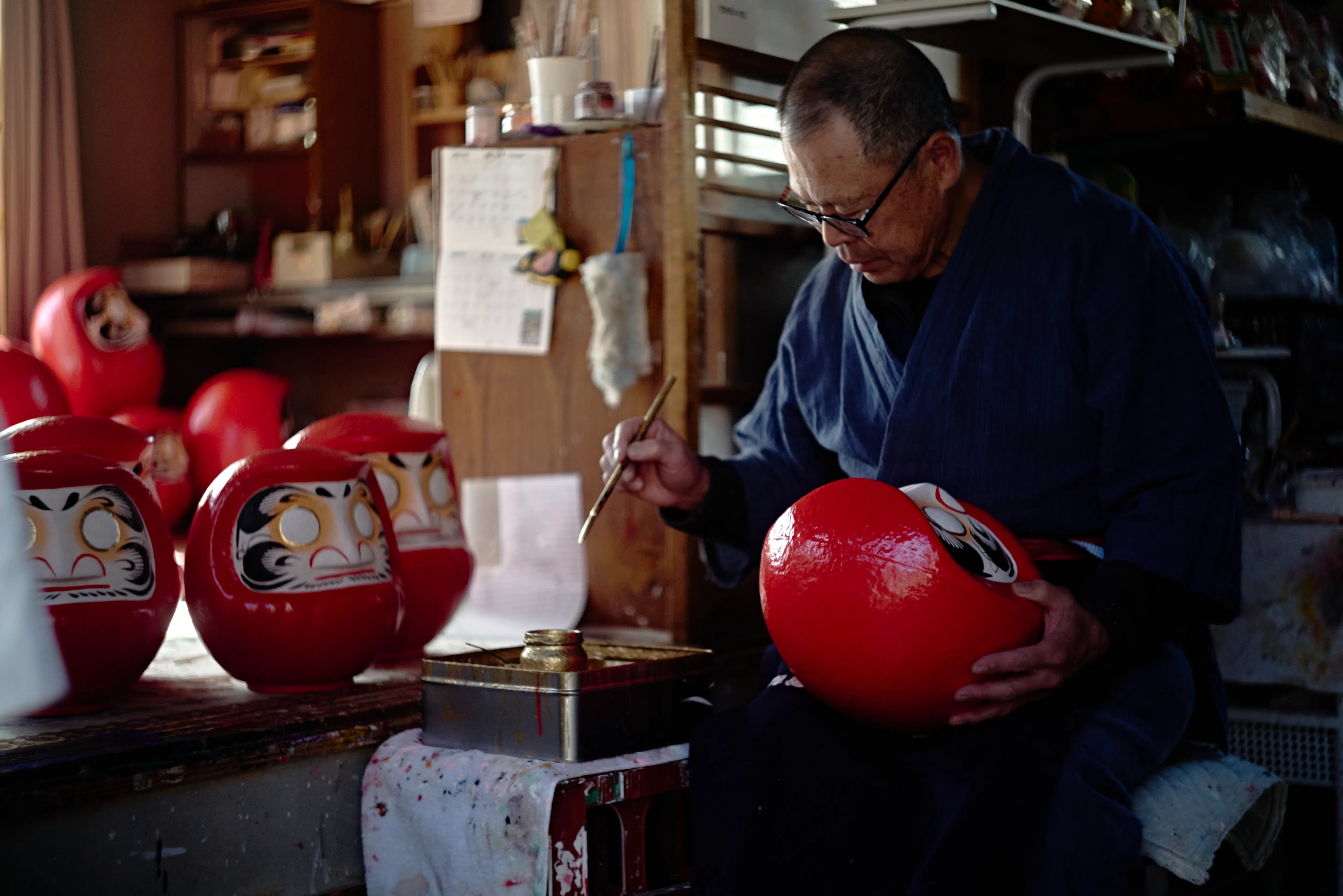
Zen Craftworks’ Takasaki Daruma painting workshop publishes fixed starts at 11:00 a.m., 1:00 p.m., and 3:00 p.m., a duration of about 90 minutes, and same-day take-home in a drawstring bag.
Do not use this version until you can select a date and complete payment. Once the 3:00 p.m. booking is confirmed, it can replace—not join—the morning stencil-dyeing session and become the final stop:
| Time | Conditional route |
|---|---|
| 8:45–10:45 a.m. | Nijo Castle and Ninomaru Palace |
| 10:45–11:15 a.m. | Walk or use the subway toward Karasuma Nijo |
| 11:15 a.m.–12:00 p.m. | Incense exhibits |
| 12:00–1:25 p.m. | Lunch and transfer toward Sanjo Takakura |
| 1:25–2:20 p.m. | Kyoto art and history exhibitions |
| 2:20–2:45 p.m. | Walk to the workshop area and check in |
| 3:00–4:30 p.m. | Confirmed Daruma-painting workshop |
Do not book both workshops. Two workshops would remove the buffer that makes the route reliable.
If a stop is unavailable
- Morning workshop unavailable: move the route to another date. Use a replacement only after its location, start, duration, confirmation, and take-home rules are verified.
- Ninomaru Palace closed: choose another date. The grounds may open on some palace-closure days, but the route loses an important part of its cultural sequence.
- Incense exhibits closed: continue directly to the final museum and allow a longer visit.
- Final museum closed: finish after the incense stop. Extending the castle or lunch is safer than adding a late cross-city transfer.
- Heavy rain: use the subway for the Nijo-to-Karasuma Oike segment and preserve extra station time.
- Running late: reduce the final museum visit first.
The purpose of this Kyoto craft and culture itinerary is not to fit in as many attractions as possible. It is to complete one hands-on activity, reach the early-closing cultural stops on time, eat without rushing, and finish the day with an object you can actually carry home.
If you are booking for one person, confirm the minimum-participant and session-format rules in the guide to Kyoto craft workshops for solo travelers before fixing the route.