


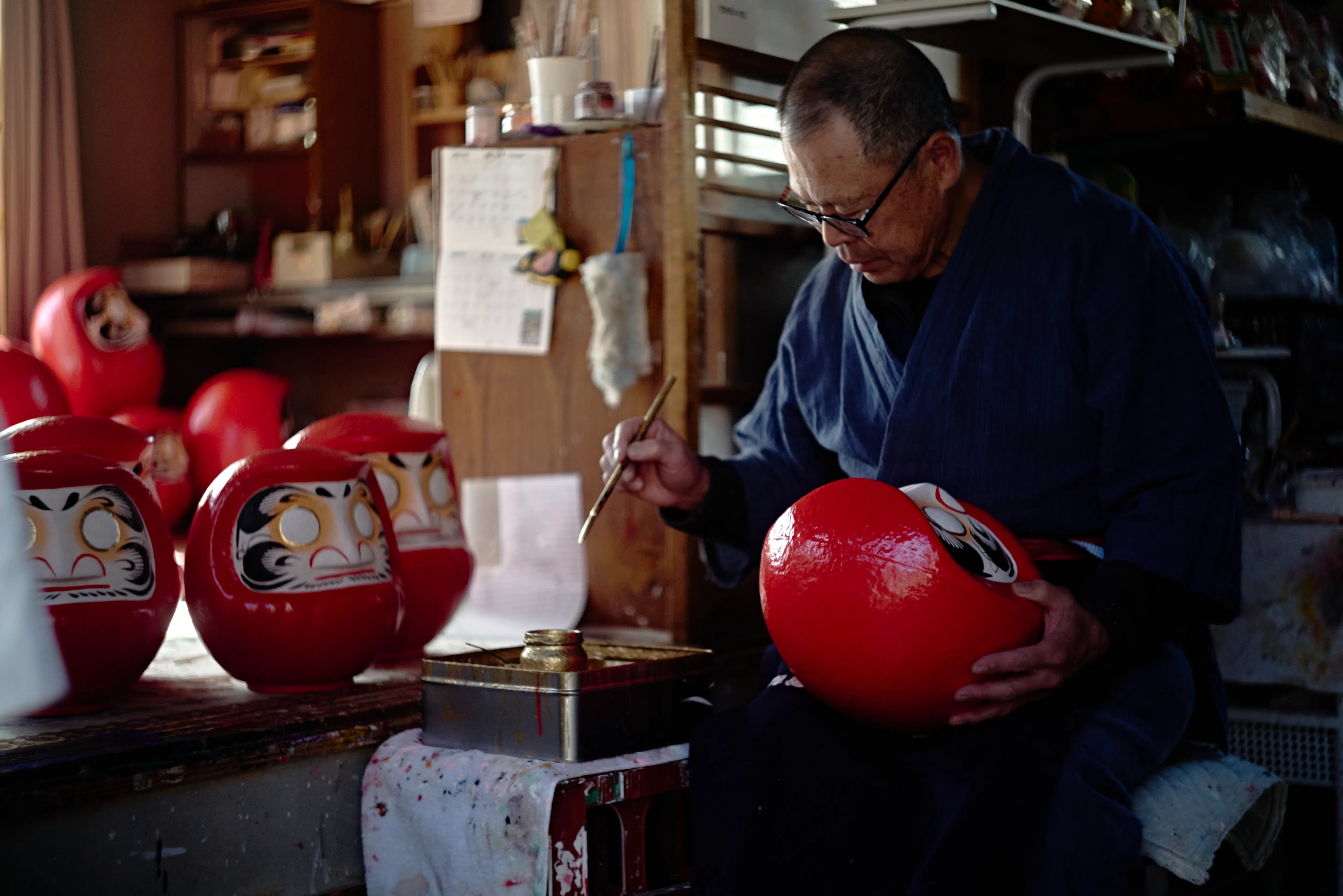

Place a Daruma doll somewhere clean, raised, stable, and visible after you set a goal and paint the first eye. A desk, shelf, entryway table, home altar, study area, or workspace can all work. The best spot is the one where seeing the unfinished eye naturally brings your goal back to mind.
There is no single compass direction that every Daruma must face. If its maker, temple, or local tradition gave you specific guidance, follow it. Otherwise, choose visibility and respectful care over a rigid rule about east, west, north, or south.
Daruma placement at a glance
| Your situation | A practical place |
|---|---|
| Study or exam goal | Desk, bookcase, or study shelf |
| Work or business goal | Office desk, studio shelf, or reception area |
| Creative project | Worktable or shelf near your materials |
| Family goal | Living-room shelf or home altar |
| New beginning | Entryway table or a calm, visible shelf |
| Daily habit | A stable surface near the place where the habit happens |
Keep the doll off the floor, away from moisture, and clear of any edge where it could fall. It does not need a formal altar to serve its purpose, but it should not look forgotten or casually discarded.
Why placement matters
A Daruma is meant to stay incomplete while you work toward a goal. You paint one eye at the beginning, put the doll where you will notice it, and complete the other eye when the goal is reached. Its location is therefore part of the practice, not just a decorating choice.
The most useful placement creates a quiet connection between the object and the work. A study Daruma belongs near the books or desk you use. A business Daruma makes sense in the office or shop. For a private goal, a shelf in your room may feel more appropriate than a public entrance.
If you have not started the eye ritual yet, the guide to using a Daruma doll explains the full sequence.
The best places to put a Daruma at home
On a desk
A desk is a strong choice for study, writing, planning, job searches, and other goals that require regular work. The doll appears at the moment you sit down to act, which makes the reminder specific rather than abstract.
Leave enough space around it that papers and cables do not hide it. If the desk is frequently moved or crowded, use a shelf just above or beside it.
On a shelf or cabinet
A shelf suits long-term and personal goals. It keeps the Daruma stable and visible without taking up active workspace. Choose a height you naturally look toward; a doll placed above your normal sight line may be respectful but ineffective if you never notice it.
A sideboard or cabinet works in the same way, provided the surface stays dry and uncluttered.
Near the entrance
An entryway table can mark a new start or a household goal. You see the Daruma when you leave and when you return, creating a simple daily rhythm.
Use a raised indoor surface rather than putting the doll on the floor or outdoors. Avoid a busy ledge where bags, keys, or doors could knock it down.
On a home altar
A home altar or kamidana can be appropriate when it fits your household practice. Place the Daruma with the same care you give the other objects there. If your family tradition or the source of the doll specifies a position, that guidance takes priority.
An altar is optional. A well-kept shelf or desk can be equally suitable for everyday goal setting.
In a studio or workspace
Put a creative Daruma near the place where you paint, write, practise, or build. In an office, a stable shelf or a clear corner of the desk usually works better than a low cabinet behind you. In a shop, choose a visible surface that does not interfere with customers or daily work.
Match the place to the goal
Before choosing a room, ask when you need the reminder most. The answer is often more useful than a rule about where Daruma are “supposed” to go.
| Goal | Placement logic |
|---|---|
| Pass an exam | See the doll when you begin each study session. |
| Finish a project | Keep it near the project tools or schedule. |
| Build a business | Place it where planning or customer work happens. |
| Maintain a habit | Put it near the cue that starts the habit. |
| Share a family intention | Choose a common room where everyone involved will see it. |
| Recover from a setback | Use a calm, personal place that does not turn the goal into a public performance. |
If the location makes you anxious, exposes a private goal, or becomes visual clutter, it is not helping. A Daruma should support attention without creating pressure.
Does a Daruma need to face a certain direction?
No universal rule requires every Daruma to face the same direction. Practices can vary by region, maker, temple, or household. Some people choose a direction for personal reasons, but that choice should not be presented as a rule for all Daruma.
Without specific instructions, face the doll into the room where you can see its eyes. Check that the surface is level, the front is not blocked, and direct sunlight or damp air will not damage the paint or paper body.
Where not to put a Daruma
Avoid locations that are dirty, hidden, unstable, or likely to damage the doll:
- directly on the floor;
- in a bathroom or another damp area;
- next to a sink, cooker, or open flame;
- on an unstable ledge;
- behind books, boxes, or other objects;
- in a pile of unrelated decorations;
- anywhere it is likely to be knocked over or forgotten.
These suggestions are practical as well as respectful. A papier-mâché Daruma can be affected by moisture and heat, and a hidden Daruma cannot work as a visible reminder.
Can you move a Daruma after placing it?
Yes. Move it if the first location becomes cluttered, unsafe, or disconnected from the goal. A new study space, office, or home may call for a new position.
You do not need to restart the goal or repaint the eye. Simply choose a more useful place and continue. Moving the doll with a reason is different from shifting it around every day as if it were an ordinary ornament.
What if you have more than one Daruma?
Give each doll enough space to remain legible. If they represent different goals, placing them near the relevant activity can be clearer than grouping all of them on one shelf. If several belong to one household intention, displaying them together may make sense.
Avoid starting so many goals that none receives attention. The placement should clarify what matters, not create a row of unfinished obligations.
Common questions about Daruma placement
Where should I put my Daruma doll?
Put it on a clean, stable, raised surface where you will see it regularly. A desk, shelf, entryway table, home altar, or workspace can all be suitable.
Can I put a Daruma on my desk?
Yes. A desk is especially useful for study, work, writing, planning, and creative goals because the reminder appears where you take action.
Can a Daruma go near the entrance?
Yes, if it has a dry, raised, uncluttered surface indoors. An entrance works well for a new beginning or shared household goal.
Should a Daruma face east?
Not as a universal rule. Follow any instructions that came with the doll; otherwise, position it so the face is visible and the body is safe.
Should I place the Daruma before or after painting an eye?
Choose the goal and paint the first eye, then place the doll where it can remind you to continue. You can select the physical spot beforehand if that helps you plan.
A place that keeps the goal present
Good Daruma placement feels almost obvious once the goal is clear. Put the doll near the work, keep it clean and visible, and let the unfinished eye prompt your next step. When the location stops doing that, move it to one that does.
For the history, symbolism, colors, and complete ritual, read the Daruma doll guide. If space is a concern, the Daruma size chart compares common dimensions and viewing distance.

