


The best Kyoto rainy-day activities do more than keep you indoors. A workable plan also keeps the uncovered part of your route short, limits cross-city transfers, and gives you enough time to reach anything with a fixed start.
In heavy rain, choose one enclosed anchor close to transit. In steady rain, pair a reserved indoor activity with a flexible sheltered stop nearby. In light rain, mixed indoor-outdoor attractions can work if the indoor part is open on your exact date.
Compare rainy-day options by total exposure
The times below are planning allowances, not operator promises. Add time for transportation, finding the entrance, storing an umbrella, and checking in.
| Option type | Weather exposure | Transit-to-door gap | Reservation | Fixed start | Time to allow | Best fit |
|---|---|---|---|---|---|---|
| Station-connected shopping or dining | Minimal or none on a connected route | No outdoor segment when you stay inside the connection | Usually no | No | 30 minutes–2 hours | Heavy rain, a sudden change, or time near Kyoto Station |
| Museum or exhibition | Low after entry | Usually short to moderate; check the exact exit or bus stop | Often optional for general admission | Usually no | 1–3 hours | A flexible cultural block |
| Cultural or craft workshop | Low after entry | Venue-specific | Recommended or required | Usually yes | 75–120 minutes plus arrival buffer | A scheduled hands-on anchor |
| Cooking class | Low after entry | Venue-specific; a nearby bus stop may reduce the walk | Usually required | Yes | 3–4 hours including arrival | A half-day indoor plan |
| Indoor performance | Low after entry | Usually a short exposed walk | Recommended | Yes | 75–120 minutes including arrival | Evening plans with little movement after entry |
| Covered market or shopping arcade | Sheltered but open-sided | Outdoor approaches and crossings remain | No | No | 45–90 minutes | Light or moderate rain and flexible timing |
| Indoor-heavy family attraction | Low to moderate | Short to moderate | Often optional | Some programs may be timed | 2–4 hours | A longer single-location visit |
| Palace or temple interior | Mixed | Grounds and routes between buildings may be exposed | Varies | Usually no | 1–2 hours | Light rain after confirming the interior is open |
Choose by rain intensity
Heavy or wind-driven rain
Prioritize a weather-tight route. A station-connected dining or shopping complex is the safest immediate fallback. For a more substantial activity, choose one enclosed museum, workshop, class, or performance with a short final walk.
A single strong anchor is usually better than several scattered stops. Three “indoor” attractions across the city can expose you to more rain than one venue that keeps you occupied for two or three hours.
Do not build a heavy-rain plan around an open-sided arcade, exposed grounds, or an attraction spread across several buildings.
Steady rain
A reserved indoor experience can work well with a flexible stop in the same area. Set the workshop, class, or performance time first, then place a museum, covered arcade, meal, or café before or after it.
Compare subway and bus approaches. A venue described as a ten-minute walk from a station may have a bus stop much closer to the door. In wet weather, the final exposed walk can matter more than the total number of transit stops.
Light or intermittent rain
Mixed attractions become more practical. A palace interior, temple hall, indoor-heavy family attraction, covered market street, or short garden section may fit the day.
Confirm that the main indoor component is open, wear shoes with reliable grip, and avoid long exposed grounds if the forecast may worsen.
Choose by the time you have
Less than 90 minutes: Stay near your current station or neighborhood. A connected complex, compact exhibition, or covered shopping street is more reliable than traveling to a fixed-time activity. Choose a reservation only when the venue is already nearby and the booking is confirmed.
Two to four hours: Select one meaningful anchor. A museum, cultural session, craft workshop, cooking experience, or indoor-heavy attraction can fill the block without several transfers. Add a meal or sheltered walk nearby rather than crossing the city for a second major activity.
Most of the day: Use two anchors in the same part of Kyoto. Put the fixed reservation first and the flexible option second. Leave open time between them; rain slows boarding, street crossings, navigation, and umbrella handling even when transit runs normally.
Choose by where you already are
Kyoto Station and Umekoji
Start with station-connected options when the rain is strongest. For a longer visit, use rail or a close bus connection to reach an indoor-heavy attraction rather than walking the full distance from Kyoto Station.
This area works especially well on an arrival or departure day, when returning to the station for a meal is easier than adding another exposed transfer.
Downtown around Shijo, Kawaramachi, and Karasuma Oike
Downtown makes it easier to combine a museum, scheduled workshop, tea experience, performance, meal, and covered shopping arcade within one area.
Arcades and market streets can connect parts of the plan, but they are not sealed indoor spaces. Expect exposure at station exits, intersections, and open entrances.
Okazaki and Higashiyama
Museums and participatory cultural activities can form a strong rain plan, but check the final approach. A bus may leave you closer than the subway. Stone-paved streets, slopes, narrow lanes, and alley entrances can also make the walk slower than the map suggests.
Outer districts
Stay in an outer district when you already have a worthwhile indoor reservation there. Do not cross Kyoto simply because a distant attraction appears on an indoor-activities list. In poor weather, the journey can take more time than the activity.
Check whether an activity is really weather-safe
Before committing, verify:
- Is the core activity inside one enclosed building?
- How many uncovered minutes are there from the nearest practical station exit or bus stop?
- Do you cross a courtyard, garden, park, or street between buildings?
- Is the intended gallery, palace room, hall, or exhibition open on your exact date?
- Is there a fixed start, required arrival time, or restricted late entry?
- Are umbrella stands, lockers, or luggage storage available?
- Will you remove your shoes? Carry dry socks for traditional interiors when required.
- Can rain or severe weather change the schedule?
- Does anyone in your group need step-free access or an elevator?
A roof provides shelter, but it does not prove that an activity is weather-safe. Covered streets remain open-sided, and a roofed ride can still admit wind-driven rain or be canceled because of weather.
Where a craft workshop fits
A craft workshop works best as one reserved indoor anchor. Confirm that the making takes place in one enclosed room, calculate the walk from transit, and leave an arrival buffer for wet streets and umbrella storage.
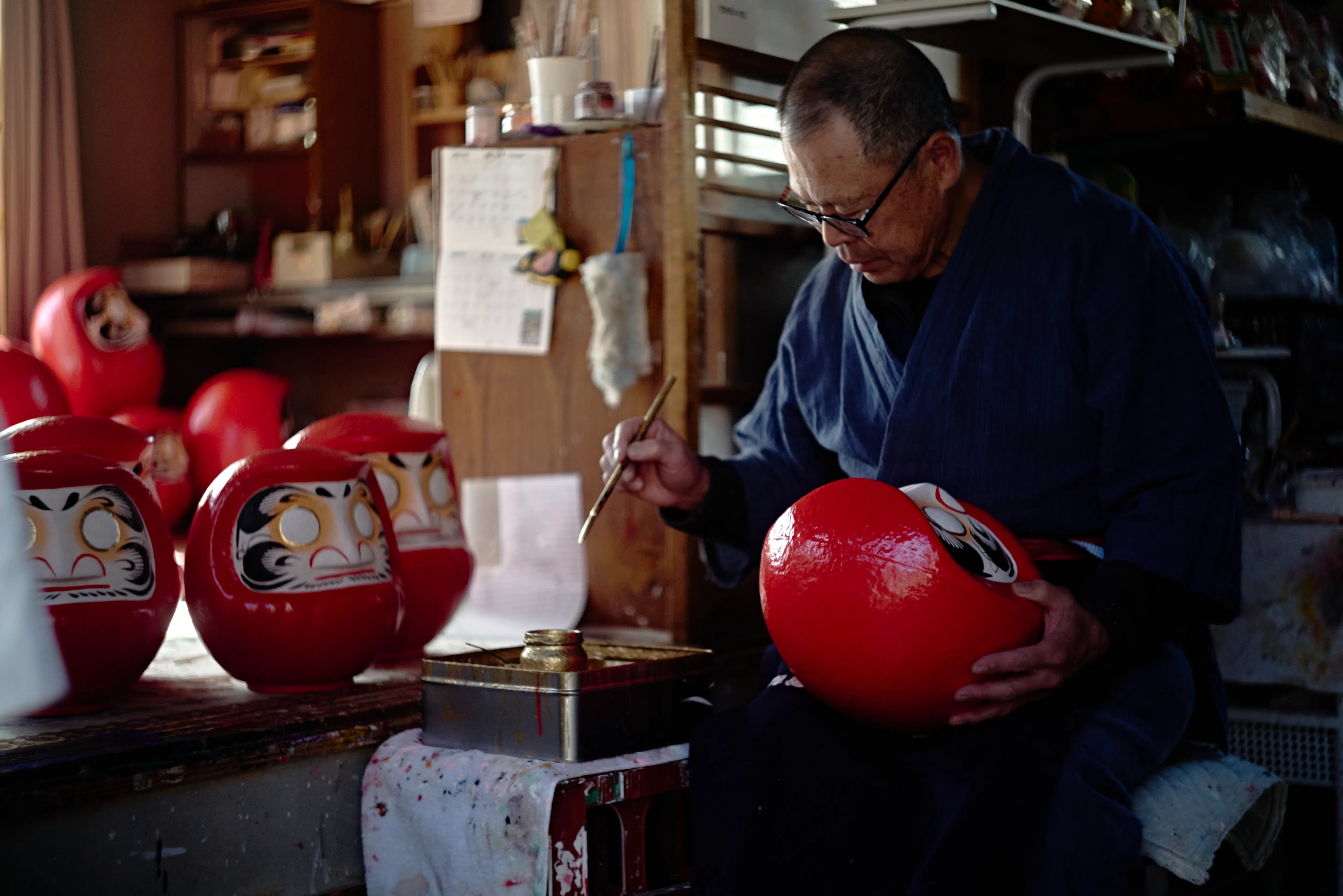
According to the current Workshop page, the Takasaki Daruma painting workshop at Zen Craftworks takes place in a second-floor room in downtown Kyoto, lasts about 90 minutes, and has fixed start times. Check current dates and conditions on the Workshop page before planning the rest of the day; do not assume walk-in space is available.
The public page does not say whether there is a step-free route or elevator, or how umbrellas and weather-related cancellations are handled. Travelers who need those details should contact the workshop before booking.
Four workable rain plans
Heavy rain near Kyoto Station: Use a station-connected meal, shopping area, or short indoor stop first. If conditions remain manageable, continue by rail or a close bus connection to one indoor-heavy attraction. Return to the station area for dinner instead of adding another exposed transfer.
Steady rain downtown: Reserve one cultural or craft workshop, allow extra arrival time, and use a nearby museum or covered shopping arcade before or after it. An indoor performance can extend the plan into the evening without changing districts.
Light rain in Okazaki or Higashiyama: Choose a museum or booked cultural experience as the main event. Add a meal nearby. Include a palace, temple interior, or limited outdoor section only after confirming that the indoor area is open.
A half day with children: Select one indoor-heavy attraction with enough content for several hours, then eat near the same station or inside a connected complex. Avoid a sequence of short attractions on opposite sides of Kyoto.
The best rainy-day option is not necessarily the one with the strongest “indoor” label. Choose the activity that fits the rain intensity, your current location, the uncovered approach, and the time you can reliably arrive.
For a broader route-by-area plan with indoor substitutes, use the full guide to things to do in Kyoto.