


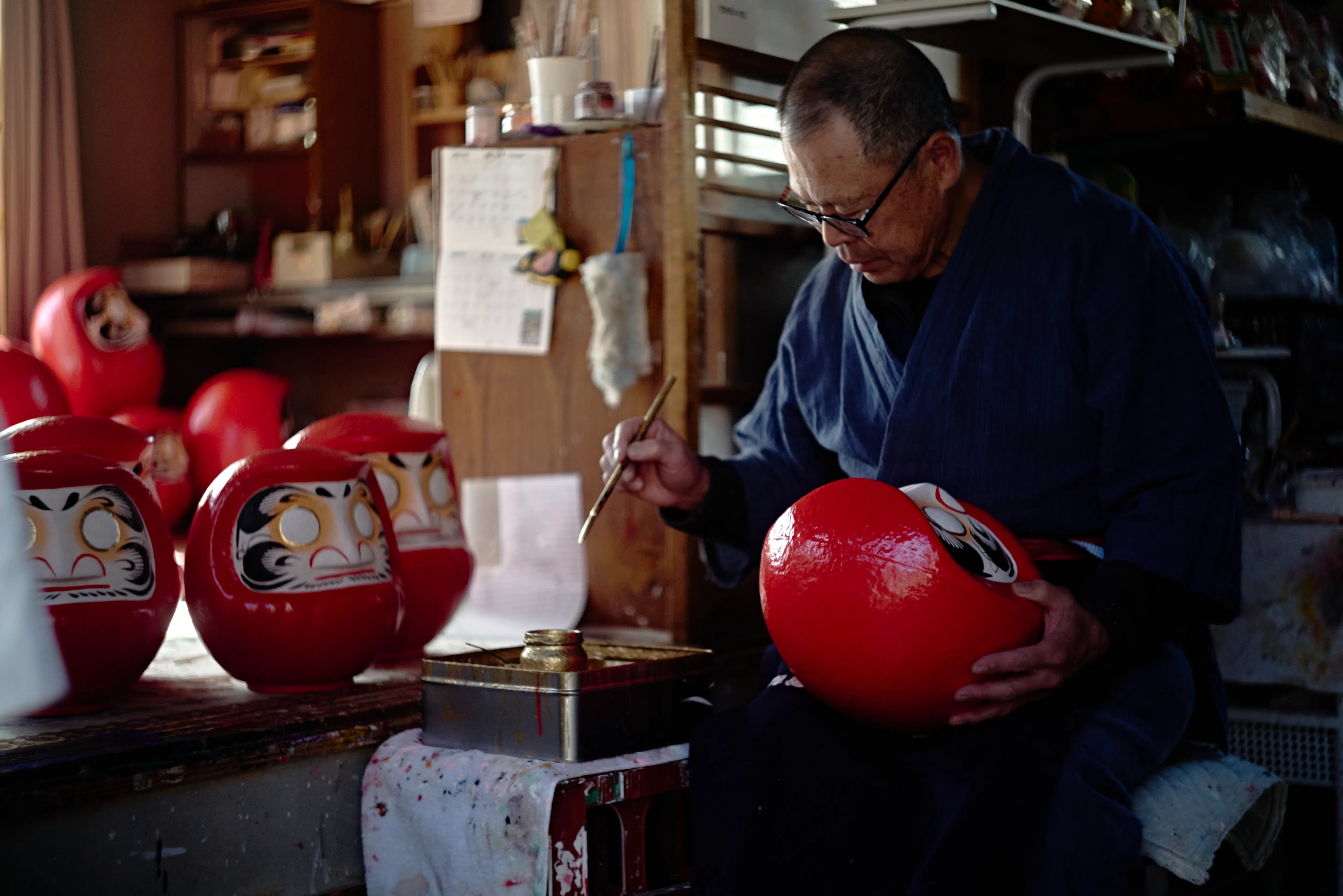

To pronounce Daruma, say da-ru-ma in three even parts. An easy English approximation is dah-roo-mah. Keep the middle ru audible: the word should not collapse into “Dharma” or “drama.”
The closer Japanese pronunciation is approximately [da.ɾɯ.ma]. The r is a quick tongue tap, and the Japanese u is shorter and less rounded than the English “oo” in food. You do not need to master those details to be understood; a clear da-ru-ma works.
Daruma pronunciation at a glance
| Form | Say it as | Note |
|---|---|---|
| Daruma | da-ru-ma | Three evenly timed parts |
| Daruma doll | da-ru-ma doll | The name does not change before doll |
| だるま | da-ru-ma | Hiragana spelling |
| ダルマ | da-ru-ma | Katakana spelling |
| 達磨 | da-ru-ma | Kanji spelling, same reading |
| Dharma | usually DAR-muh or DHAR-muh in English | Historically related, but a different everyday pronunciation |
How to pronounce each sound
Da: だ
Begin with da, close to dah. Keep it short. Do not stretch it into a long English “dar.”
Ru: る
The middle sound is the part English speakers most often lose. The Japanese r is a light tap made near the ridge just behind the upper teeth. It can remind an English listener of a very quick sound between r, l, and d.
The vowel is also different from a long English “oo.” In the IPA spelling [ɯ], the lips are less rounded. For a simple approximation, roo is understandable; for a closer one, make it shorter and lighter.
Ma: ま
Finish with ma, close to mah. Let the final vowel remain audible rather than cutting the word off at “darum.”
Now put the parts together at an even pace:
da — ru — ma da-ru-ma
Japanese rhythm is organized in morae, and each of these three kana takes one beat. English speakers naturally add strong stress, but Daruma sounds clearer when no part overwhelms the others.
A ten-second practice method
- Tap the table three times at a steady pace.
- Say one part on each tap: da / ru / ma.
- Repeat without pausing between the parts.
- Make the r lighter, but do not remove the vowel after it.
- Add the next word: da-ru-ma doll.
If the result sounds like “drama,” slow down and restore the u. If it sounds like “Dharma,” check that all three beats are present.
How to pronounce “Daruma doll”
Say da-ru-ma doll. Daruma remains a three-part Japanese name; adding doll does not shorten or change it.
In ordinary English conversation, dah-roo-mah doll is a practical guide. If the listener does not know the object, you can introduce it as “a da-ru-ma doll, a Japanese goal-setting figure.” After that, Daruma on its own is enough.
How Daruma is written in Japanese
| Script | Form | Reading |
|---|---|---|
| Hiragana | だるま | da-ru-ma |
| Katakana | ダルマ | da-ru-ma |
| Kanji | 達磨 | da-ru-ma |
Changing the script does not change the reading. Hiragana is straightforward for learners, katakana may appear in design or emphasis, and 達磨 is the traditional character form.
For a fuller explanation of when each spelling appears, read Daruma in Japanese. The article on Daruma kanji meaning explains the characters and common words written on the doll.
Daruma and Dharma: related words, different pronunciations
Daruma and Dharma share a historical connection, but they are not interchangeable in modern English pronunciation.
Daruma is the Japanese form used for Bodhidharma and for the familiar round doll. It has three beats: da-ru-ma.
Dharma is a broader term from Indian religious traditions and is commonly pronounced with two syllables in English: DAR-muh or DHAR-muh. When you mean the Japanese doll, pronounce the middle vowel and say Daruma.
The doll's name is connected to Bodhidharma because its face is modeled on traditional images of the monk. That history explains the relationship between the words without making their present-day pronunciations identical.
Common pronunciation mistakes
| What you may hear | What happened | Try instead |
|---|---|---|
| “Dharma” | The middle u disappeared | Say da-ru-ma on three beats |
| “Drama” | The first two parts ran together | Pause briefly after da while practising |
| “Dar-ma” | The word became two syllables | Restore the ru |
| A heavy “rrrr” | The English r was overemphasized | Use one quick tongue tap |
| “Da-roo-MAH” | Stress became too strong | Keep the three parts more even |
| “Darum” | The final vowel disappeared | Finish with a clear ma |
Perfect imitation is not required. It is better to keep all three parts clear than to force the tapped r and lose the rhythm.
What does Daruma mean?
Daruma names a Japanese figure modeled on Bodhidharma. The familiar doll is round, often made from papier-mâché, and weighted so that it returns upright after being tipped. It represents perseverance, good fortune, and continuing toward a goal after a setback.
Many Daruma begin with blank pupils. The owner paints one when setting a goal and the other when the goal is achieved. If pronunciation brought you here and you now want the cultural context, start with Daruma symbolism.
Quick answers
Is Daruma two syllables or three?
It has three Japanese morae, which can be heard as three clear parts: da-ru-ma.
Is the r like an English r?
Not exactly. It is normally a brief tongue tap [ɾ], lighter than the common English r. A gentle English r is still understandable.
Is “dah-roo-mah” accurate?
It is a useful English approximation. The native Japanese u is shorter and less rounded than “oo,” so [da.ɾɯ.ma] is a closer technical guide.
How do you say Daruma doll in Japanese?
The object is commonly called daruma (だるま or 達磨). In English, “Daruma doll” helps identify the object, but the Japanese name itself does not need the word doll.
Keep the three beats
The most reliable pronunciation rule is simple: do not lose the middle sound. Say da-ru-ma, keep the rhythm even, and let the final ma finish the word. Once that feels natural, speed up without turning three beats into two.
For the complete meaning, history, and use of the object, continue with the Daruma guide.

